
General News
COVID-19 fuels domestic violence, forced marriage in Sudan – Study


Deteriorating economic conditions since 2020 and the COVID-19 pandemic have fuelled an increase in domestic violence and forced marriage in Sudan, a UN-backed study has revealed.
The study, Voices from Sudan 2020, published this week is the first-ever nationwide qualitative assessment of Gender-Based violence (GBV) in the country, where a transitional government is now in its second year.
Addressing the issue is a critical priority, according to the UN Population Fund (UNFPA) and the Government’s Combating Violence against Women Unit (CVAW), co-authors of the report.
“The current context of increased openness by the Government of Sudan, and dynamism by civil society, opens opportunities for significant gains in advancing women’s safety and rights,” they said.
The report aims to complement existing methods of gathering data and analysis by ensuring that the views, experiences and priorities of women and girls, are understood and addressed.
Researchers found that communities perceive domestic and sexual violence as the most common GBV issues.
Key concerns include physical violence in the home, committed by husbands against wives, and by brothers against sisters, as well as movement restrictions which women and girls have been subjected to.
Another concern is sexual violence, especially against women working in informal jobs, but also refugee and displaced women when moving outside camps, people with disabilities, and children in Qur’anic schools.
Forced marriage is also prominent, according to the report. Most of these unions are arranged between members of the same tribe, or relatives, without the girl’s consent or knowledge.
Meanwhile, Female Genital Mutilation (FGM) remains widespread in Sudan, with varying differences based on geographic location and tribal affiliation.
Although knowledge about the illegality and harmfulness of the practice has reached community level, child marriage and FGM are not perceived as key concerns.
Women’s access to resources is also severely restricted. Men control financial resources, and boys are favoured for access to opportunities, especially education.
Verbal and psychological pressure to comply with existing gender norms and roles is widespread, leading in some cases to suicide.
The deteriorating economic situation since 2020, and COVID-19, have increased violence, especially domestic violence and forced marriage, the report said. Harassment in queues for essential supplies such as bread and fuel has also been reported.
Sudan continues to move along a path to democracy following the April 2019 overthrow of President Omar Al-Bashir who had been in power for 30 years.
In addition, the report stated that it has not been possible for the last three decades to discuss GBV.
“GBV data is dramatically lacking, with no nation-wide assessment done for the past 30 years, and a general lack of availability of qualitative and quantitative data,” the authors said.
To carry out the assessment, some 215 focus group discussions were held with communities: 21 with GBV experts, as well as a review of existing studies and assessments.
Research was conducted between August and November 2020, encompassing 60 locations and camps, and the data was scanned through a software for qualitative analysis, followed a model first used in Syria. (NAN)


At a solemn ordination service in Abuja, senior church leaders have called on pastors to make the well-being of their congregations a top priority, following the example of Jesus Christ.
Speaking during the priesthood ordination and installation of a Sub Dean at the Cathedral Church of Advent, Life Camp, Abuja, the retired Bishop of the Anglican Diocese of Okene, Rt. Rev. Emmanuel Ajulo, described pastors as shepherds charged with the care of their flock. He urged them to shun worldly distractions and focus on meeting the spiritual and material needs of their members.
Bishop Ajulo also encouraged the newly ordained priests to remain faithful to their calling by teaching God’s word without compromise.
In his charge, the Primate of the Church of Nigeria, Anglican Communion, Most Rev. Henry Ndukuba, urged the new clergy to preach the undiluted gospel and foster religious harmony wherever they serve. He expressed confidence that their new roles would help promote peace and unity in society.
The service also featured prayers for national leaders and divine intervention in addressing the current global economic challenges.

In a dramatic show of faith and patriotism, over 1,000 fiery prayer warriors from across Nigeria will descend on Ilorin, Kwara State, this Saturday, lifting their voices in intense intercession for President Bola Tinubu’s success and Nigeria’s survival in the face of biting economic woes and mounting insecurity.
The spiritual siege, themed “Walking in Domini”, is the maiden convention of the Organisation of African Instituted Churches (OAIC), with its Kwara State Chairman, Evangelist Thomas Adeboye, vowing that “heaven will hear and respond to Nigeria’s cry.”
Aside from marathon prayers, the gathering will roll out free medical outreach to locals across Kwara’s LGAs, a gesture aimed at touching both body and soul.
Adeboye, lamenting Nigeria’s “troubling economic and security realities”, called for a nationwide prayer uprising, insisting that Tinubu has shown the will to revive the nation but needs massive divine backing to succeed.
“Banditry, a collapsing economy, and political tension demand we seek God’s face like never before,” he declared. “We will storm heaven for wisdom for the President and governors to steer Nigeria to safety.”
The convention will also feature awards to distinguished personalities, soul-lifting worship, fiery sermons, and unity-driven lectures—all capped with thunderous prayers for Nigeria’s redemption.
Adeboye urged the President to ensure every policy has “a human face,” stressing that Nigerians must not only endure but also enjoy the fruits of governance.
With the OAIC promising to reaffirm believers’ authority in Christ and rally spiritual boldness in the face of national challenges, Ilorin is set to become the epicentre of a powerful spiritual warfare for Nigeria’s destiny.
…Church leaders accuse Welsh counterparts of “spiritual decadence” and “abandonment of faith”
The Church of Nigeria (Anglican Communion) has issued a forceful condemnation of the election of Rt. Rev. Cherry Vann, an openly lesbian cleric, as the Archbishop of Wales. The move is the latest in a series of developments that have deepened divisions within the global Anglican Communion over sexuality and doctrine.
In a statement from Primate The Most Rev’d Henry Ndukuba, the church denounced the election as a “serious departure from biblical teaching” and a sign of “spiritual decadence” and “an outright abandonment of the faith once delivered to the saints.”
Archbishop Ndukuba warned that Bishop Vann’s elevation compromises the Anglican Church’s global mission and could obstruct evangelism. He compared the situation to the controversial tenure of Most Rev. Katherine Jefferts Schori, former Presiding Bishop of the U.S. Episcopal Church, who also faced intense criticism from conservative Anglicans for her progressive views.
The Primate accused Bishop Vann of being complicit in the “ongoing crisis” around same-sex issues, stating that the election is a “clear revelation that many who claim to be members of the body of Christ cannot endure sound doctrine” (2 Timothy 4:3–4).
The Church of Nigeria called on Anglicans worldwide to reject “rebels” and “apostates” and to instead support conservative bodies like the Global Anglican Future Conference (GAFCON).
“The Church of Nigeria (Anglican Communion) condemns, unequivocally rejects, and will not recognize the election of Rt. Rev. Cherry Vann as Archbishop of Wales,” Ndukuba declared. He concluded with a solemn warning that without repentance, the Church in Wales risks losing “complete relevance” and its leaders will face judgment.

68 Nations Gather at Dunamis Glory Dome for 2025 Flaming Fire Conference
The 2025 International Ministers Flaming Fire Conference has drawn thousands of worshippers, church leaders, and delegates from more than 68...

“I Am Living Proof That God Still Saves – Faith Oyedepo Shares Testimony”
Faith Oyedepo, wife of the Founder and General Overseer of the Living Faith Church Worldwide, Bishop David Oyedepo, has shared...

Olukoya Ordains 5,000 Pastors at MFM Global Ministers Conference
The General Overseer of Mountain of Fire and Miracles Ministries (MFM) Worldwide, Dr. Daniel Olukoya, has ordained 5,000 men and...
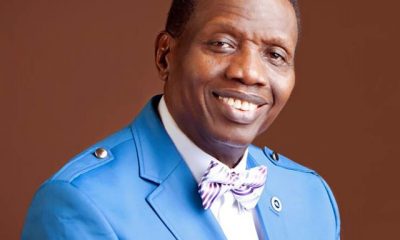

From Barefoot Village Boy to Global Spiritual Leader: Adeboye Inspires at Church’s 50th Anniversary
Pastor Enoch Adeboye, General Overseer of the Redeemed Christian Church of God (RCCG), has shared a moving account of his...

Clergy Urged To Put Members’ Welfare Above All Else
At a solemn ordination service in Abuja, senior church leaders have called on pastors to make the well-being of their...